

The Shift
Three per cent is the figure for fake hires that get caught on day one according to a HYPR survey of 500 US HR executives (reported in Infosecurity Magazine). Nearly two-thirds of the fake hires take four days or more to be detected and by that stage they will have a company login and on average 5.73 days inside the network with no one watching.
Now look at where the spend is. HireVue rolled out fraud detection for interviews and assessments on November 10. Pindrop just launched its own tool for resume review and live interviews. Checkr asked 3,000 hiring managers where they focus on fraud: 63% said before the hire, just 6% said after. So most of the money is at the front door.
We're building a taller wall at the front door, but the people who get through are already inside. Candidate fraud isn't a screening problem. It's a handoff problem. We check identity once on the TA side, then hand it to IT days later, and nobody actually carries the identity across. The gap is right there.
The Evidence
Fraud's been showing up in our networks for a couple of years and it's only gotten worse with the AI security mess. The numbers back it up. Checkr found 86% of orgs had at least one hiring fraud case last year, and 40% of managers had personally interviewed someone using a fake identity. HYPR says 98% of HR leaders have seen it. Gartner's call that one in four candidate profiles will be fake by 2028 is one I've already written about.
Here's the thing. All those numbers are just what we catch at the front of the funnel. They tell us nothing about what happens to the ones who get through.
HYPR's data does. Fraudulent candidates pass the pre-hire screening and go on to start work in 42% of cases. The clock then starts.
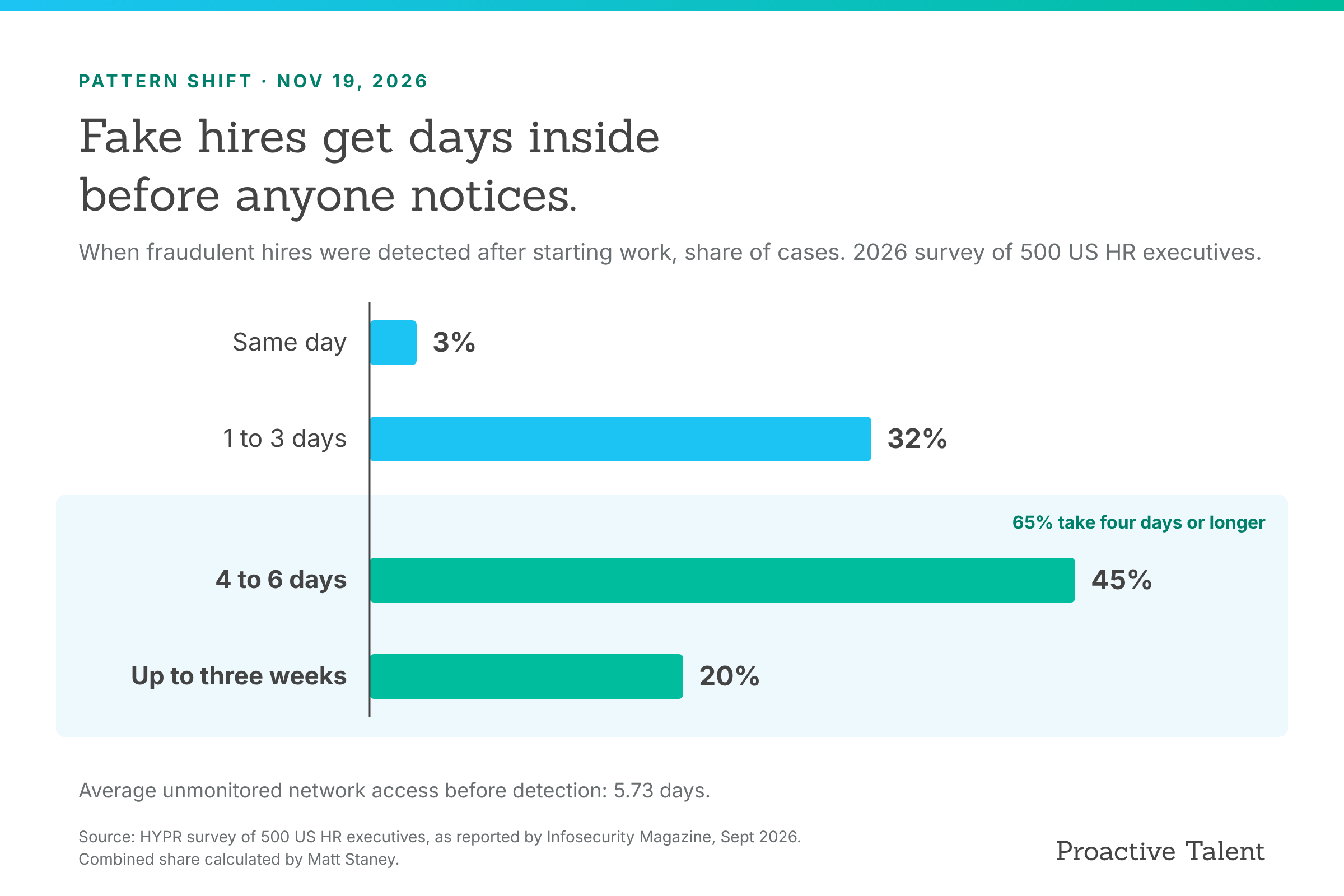
Source: HYPR survey of 500 US HR execs, published 15th Sept 2026 as reported by Infosecurity Magazine. The shares are of fraudulent hires that actually started work. The combined 65% is my maths.
Help Net Security's reading of the same report is that by the time post-hire fraud is detected, 98% of the hires in question already have company credentials.
If the survey data seems a bit abstract then the federal case file is very much the opposite. On 13th October the Department of Justice charged 14 people in a North Korean remote IT worker scheme which had impacted over 70 US companies between 2019 and July 2025. The companies affected were in the health care, communications, cyber support, retail and manufacturing sectors and were based in 17 states. So this is not just a problem for tech companies. Over 40 homes in Texas were searched and approximately 187 laptops and remote access devices were seized.
Think about what a laptop farm is. It's a house full of laptops that the employer sent over themselves after the offer and after every single check had been passed.
The FBI alert that went out on the same day is the uncomfortable bit. It details what these networks are now paying Americans to do, which includes "participate in job interviews", "verify fraudulent identities" and "complete drug tests and fingerprinting". So a real person with a real face and a real ID has the interview and then someone else does the job. No deepfake detector is going to pick that up as anything is fake in the interview.
The Pattern
So how does a fake hire actually last almost six days inside a company that ran every check?
Ownership changes at the very peak of the risk. In the HYPR survey 53% of HR heads said they own the hiring identity risk prior to an offer being accepted. Talent acquisition 19%, Security 10%, IT 7%. Channel Insider's take on the same survey is that once the credentials are in existence the identity and access team own it at 73% of organisations and HR at 15%. Help Net Security put the gap succinctly: "There is no owner in that period."
Checkr's numbers fill in the rest. Half of managers verify identity after at least one live interview, and 44% have no formal written process for post-hire ID checks. We verify once, then trust the paperwork. That's it.
David Manaster wrote in August that no-one wants to own candidate fraud, citing Kyle Lagunas: "CISOs don't really want this". That's exactly what we're hearing. Both sides are sure the other owns it. We went from the lowest risk area in the business to one of the biggest security holes, and nobody has actually redefined who owns what.
This week's AI news makes the same point from the other end. Anthropic priced its IPO at $83 a share (well above its range) and the stock shot up when it went live today. That's the story that got the headlines. The detail I want to highlight is much smaller. When Anthropic released its latest models on 9th November it kept the unfiltered version (Mythos 5.2) available to organizations that go through its verification programmes. Three days later it shipped out Claude Meetings, an AI which joins a Google Meet call as a visible participant. So the AI labs are checking who you are before they hand over their most capable model and they're now shipping a stranger a laptop which has a non-human participant in a video call. A video call which by design now has a non-human participant.
Getting it wrong costs more now than it did a year ago. October retail sales were up 0.2% after a 0.8% rise in September. The Fed minutes show almost all participants expect more rate hikes, in a labor market with low hiring and layoffs. When hiring is this scarce, every req matters. A fake hire costs you the req, the weeks it took to fill, and the cleanup. You don't get your recruiter capacity back.
My Read
For a year I've been saying that the first question you ask in the hiring process isn't "is this person qualified?" It's "is this even a person?" I was half right. The FBI alert indicates that the person you're dealing with in the interview is frequently a real person. The real question is whether it's the same person in the interview as it is on the background check, on the I-9, on the laptop delivery and on the first login.
Most of us are treating this as a detection problem at the top of the funnel and think the answer is a better detector. That's the wrong place to start. The FBI says no single indicator is reliable and pushes for 'identity in depth'—multiple checks across the whole employment lifecycle. A better interview tool doesn't stop a laptop from getting shipped to an address nobody's checked.
This isn't a recruiting failure. No recruiter can spot a stand-in who's a real person with real documents. Biometric Update's read of the HYPR data is that 68% of cases are caught by human observation and intuition, which just shows there's no process. What we have is the handover. TA is the only point where a human actually looks at the candidate's face. We have the first link in the chain, so we should be the ones designing the chain with security.
Last week I asked whether candidate identity belongs to TA or security. It's neither. It sits in the space between, and right now nobody owns that space.
Here's what to do. Take a recent remote hire and walk the file from application to first login with your Head of IT or Security. At each stage, record who confirmed the identity, what they checked, and whether it linked to the last check. Add one more check at the handover. Before credentials go live and before the laptop ships, have someone match a live ID to the person who did the interview. The laptop only goes to a verified address. The FBI says live verification and multiple forms of ID create the most friction for these networks.
Apply it the same way to every hire in the role and run it past counsel first. The alert is clear: aggressive controls will stop qualified people from joining. And remember what I wrote last week in Open Reqs Aren't Demand Anymore. Every check you add is one more thing between an open req and a start date. If it hurts the candidate experience without closing the gap, we shouldn't do it. One check where the risk is does more than five at the interview.
Watch This
The Fed have put the entry level job on their agenda. Barr was clear on Nov 12 that there has been "relatively little displacement of workers by AI" to date, but that AI could well be a substitute "particularly for younger, less experienced workers". Four days later Warsh opened a task force hearing with scenarios in which unemployment could be above full employment. Then Indeed Hiring Lab reported yesterday that senior level postings were 19.2% above the January 2025 levels by September, entry level and mid level postings each down around 4%, and that half of the class of 2025 are underemployed a year after graduation. If the bottom rung is moving up, where do you get your next mid level hire from? That's where I'm going next.
A question for you: Who in your company could say today that the person who logged in this morning is the person you interviewed?