


A Note Before This Week’s Edition
There was no Pattern Shift last week, and that’s because I’m excited to say that I have spent the last several weeks rebuilding Proactive Talent, my consulting practice, and expanding Talent Brand Alliance, the employer brand community I started back in 2012, into Talent Alliance Communities, a community and platform for the whole talent industry. Founding member invites are open through November 24 if you want in early. Both are the same bet this newsletter makes every week: the people who see the shift first should be building for it together. Now, back to the data.
The Shift
In September, employers in finance and insurance made 36 hires for every 100 open jobs. A year earlier, they made 59. Openings in the sector rose 12% over that year while hires fell by almost a third, according to the BLS JOLTS openings and hires tables. That isn’t a hiring freeze, because a freeze shrinks openings. It’s something else, and I think it’s the most important thing happening in our corner of the labor market right now.
My take? For knowledge work, an open req is no longer a commitment to hire, it's now an option the business holds if they can’t add that capability another way, or if skills don’t shift before someone is hired. Openings measure permission, maybe intent. Hires measure commitment. The two have come apart, and most of our dashboards still treat them as the same thing.
The Evidence
If you start with the numbers everyone repeated this week, you can kind of start to see what I’m talking about here. Indeed’s postings index showed its first year-over-year gain in more than four years, and September openings came in at 7.5 million, up from a revised 7.2 million in August. Then on Friday the October jobs report showed payrolls up 165,000, unemployment down to 4.1%, and August and September revised up a combined 84,000. Read together, it looks like demand is back.
But the same JOLTS release that showed openings rising also showed hiring at what Indeed’s Cory Stahle called the slowest pace since 2013. Fed Governor Christopher Waller described the market as “low hire, low fire” in a speech on Tuesday and said he worries it “has lost some of its dynamism.”
The national ratio hides what’s going on. Across all private employers, hires per opening were flat over the year, about 76 hires for every 100 openings both times. Split it by sector, and it pulls apart.
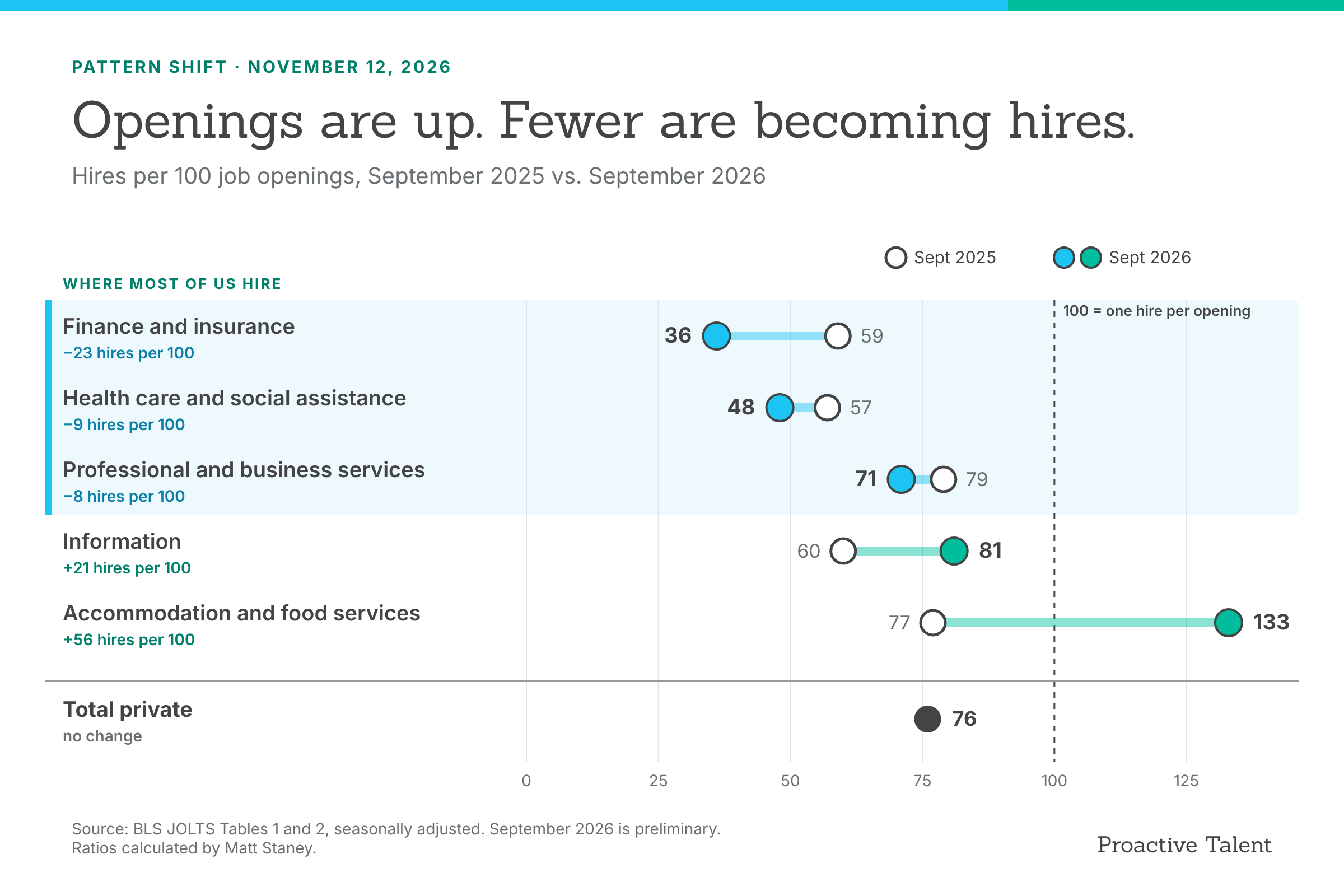
My calculation from BLS JOLTS Table 1 and Table 2, seasonally adjusted, September 2026 preliminary.
Restaurants and hotels are turning openings into hires much faster than a year ago, and that is what holds the national number steady. The office-based sectors went the other way, and so did health care, which has carried most of this year’s job growth. Information is the exception, but it rests on 94,000 hires in a single month, and I wouldn’t build anything on it yet.
A completely different dataset says the same thing about tech. Lenny Rachitsky’s late-2026 tech job market report, built on TrueUp openings at more than 9,000 tech companies and Live Data Technologies hiring data, finds engineering openings up 44% since January 2024 while engineering hiring fell 17%. U.S. software engineer hires over the 12 months to April were about 113,000, against a 2022 peak of 239,000.
The people who would fill those roles aren’t moving either. Quits in professional and business services fell from 2.4% to 2.1% over the year, and in finance and insurance from 1.3% to 0.9% (JOLTS quits). The total private quits rate did rise to 2.3%, but most of that rise came from accommodation and food services, where quits jumped from 3.4% to 5.0%. ADP’s October pay data shows job-changers getting 4.8% base pay growth against 3.0% for stayers, and ADP’s Nela Richardson credits bonuses, overtime and extra hours. That’s an hourly-work story, not ours.
The Pattern
So why would a company keep a req open and not fill it?
The Fed has part of the answer. In the same speech, Waller noted that “several Fed Districts reported firms had delayed hiring or anticipate less job creation after investing in AI.” When a CFO isn’t sure a role will exist in its current form in 18 months, the cheapest move is to approve the req and let the bar do the rationing. Post it, interview, hire only if the person is exactly right. That’s an option. It costs almost nothing to hold, it keeps the hiring manager from escalating, and it can be closed quietly in the next planning cycle.
The bar is also moving in a direction that makes options hard to exercise. Indeed found senior postings up 14.7% year over year as of May, while entry-level postings fell 7.5%, and Ashby’s benchmark data shows senior roles taking a median 71 days to fill, compared with 52 for junior roles. A req held open for an experienced person who already has a job, in a year when those people aren’t quitting, sits. Meanwhile, more than a quarter of unemployed workers have been searching for six months or longer, the longest durations since December 2021. Supply and demand both exist on paper. They don’t meet.
This is the week’s AI story for our profession, even though the AI headlines were about Anthropic’s IPO roadshow and Google opening up Gemini 4 Carbon. AI’s effect on hiring isn’t showing up as layoffs right now. Challenger counted just 1,265 AI-attributed cuts in October, the lowest month of the year, and economic conditions overtook AI as the top stated reason for 2026. It’s showing up as hesitation. The req gets approved, and the hire doesn’t happen.
Don’t believe me? The same Challenger report carries another number that measures something other than what it actually looks like. Announced hiring plans hit 444,692 in October, the highest October since at least 2009, and roughly 300,000 of that was Amazon’s seasonal plan. Announced intent and committed hiring are different things, at Amazon’s scale and at yours.
My Read
Just two weeks ago, in my edition called Two labor markets, one headline, I said the sector lines in the October payroll report would be the thing to watch. Well, I was watching the wrong report because payrolls tell you who got added. JOLTS tells you how much of the approved demand actually turned into people, and that’s the number that runs a talent function and takes up TA capacity.
The consensus reads rising openings as returning demand and the low hiring rate as caution that will clear once rates settle and 2027 budgets lock. I think that’s wrong for knowledge work. Conversion has become the constraint, and it won’t clear on its own, because an option is cheap to hold and nobody is asking anyone to exercise it.
Be precise about whose problem this is. Recruiters aren’t failing to fill these reqs. Many of them were never meant to fill at the pace the req count implies. What is ours is the reporting. Most of us still report req load as workload and openings as demand, which is how a team ends up staffed for 120 reqs that will produce 40 hires and then gets blamed for time-to-fill on roles the business never committed to. Lenny’s data shows recruiter openings at tech companies up nearly 300% since mid-2023. If companies are rebuilding recruiting capacity against req counts, some of them are sizing for a number that won’t convert. Candidates feel it too. In an Enhancv survey of 1,000 U.S. professionals, 47% said they had applied to a role they later found never existed, and from the outside, an unexercised option looks exactly like a ghost job.
Here’s the one thing I’d start this month. Run a re-commit on every req open longer than 45 days. Each hiring manager either names a target start date and blocks the interview time to hit it, or the req comes off the active list and becomes a pipeline you keep warm. Then put hires per open req by job family in front of finance, next to the openings count, before 2027 headcount is final. Plan recruiter capacity on committed reqs only. You’ll lose some req count on paper. You’ll gain a number your CFO can trust.
Watch This
Identity checks are moving inside the hiring funnel. On Tuesday, HireVue launched Advanced Fraud Detection, with document checks, face liveness, and IP and VPN signals built into interviews. Deel launched Deel Security at the end of October, pointing to a DOJ case in which remote IT workers used 68 stolen identities to get jobs at more than 300 U.S. companies. And Dayforce closed its purchase of Ribbon, an AI interviewing platform. Every verification step makes hiring safer, and every one also adds a step between an opening and a hire. Whether candidate identity belongs to TA or to security is about to become a real question. I’ll come back to it next week.
A question for you: if every hiring manager had to name a start date this week, how many of your open reqs would survive?